A self-navigating road trip sent me through misty villages, turf-roofed churches, gas-station hot dogs, and unexpected moments of calm I never could have planned myself.
It was a phrase I heard repeated over and over while I was in the Faroe Islands. The winds were calm, and the islands were illuminated by sunshine. That’s uncommon here—Tórshavn, the largest town in the islands, is famously one of the least-sunny places on earth, with just over 840 hours (a little over a month) of sunshine each year. So, to say I got sunny days four of the five days I was in the islands was rather extraordinary.
Where exactly here was, seemed to perplex even well-seasoned travelers. The Faroe Islands are a group of islands in the North Atlantic, roughly equidistant from Scotland, Iceland, and Norway. They’re an autonomous part of the Kingdom of Denmark, which is responsible for defense and foreign affairs, otherwise they’re self-governed. It’s like a tiny, non-Indigenous, ice-free Greenland.
The Faroese have even developed their own culture and language in these remote little islands. The Faroese language is most closely related to Icelandic, but the two languages aren’t completely mutually intelligible. Most Faroese also speak English and Danish.
I found the islands charming (get me a seaside town with a coffee shop and a bookstore and I’m anybody’s, really), and vowed to return, so when I had a chance to go check out these AI-guided self-drive tours, I jumped at it.
The system works entirely online, via a website operated by the Faroe Islands tourist board. I picked up my rental car at the airport, being sure to get a portable WiFi hotspot to access the website while I was driving. Once you’re ready to start, you just tell the website you’re ready, and it develops a sightseeing self-drive tour for you, with around four stops.
The system is designed to take into account other travelers using the system at the same time, so it won’t send you to the same place as someone else. The spots in the database are provided by Faroe Islanders, and they’re meant to disperse travelers across the islands, rather than grouping them on big bus tours or having everyone crowd at the same few top sites for selfies.
The fun part is that you only get the stops and directions one at a time. You can’t go through a list and pick out the things that interest you—you essentially have to unlock each stop by going to the stop before it. It’s almost counterintuitive—you cede control of your day to a website in order to have a more organic experience, but I loved each little serendipitous moment I was led to. And if you don’t find the stop particularly interesting, you just drive on without lingering.
My first stop was a fish and chips shop in Norðskáli, about a half-hour drive away on the northern island of Eysturoy. Most of the islands are quite close to each other, connected by bridges or tunnels. The itineraries work in meal and snack stops, but perhaps the one bit of feedback I have is that you don’t have any control over when the stop—if it’ll be first thing or at the end, so I learned early on it’s worth it to take snacks. I’d just eaten, so I skipped the fish and chips, but the views from the waterfront shop were delightful.
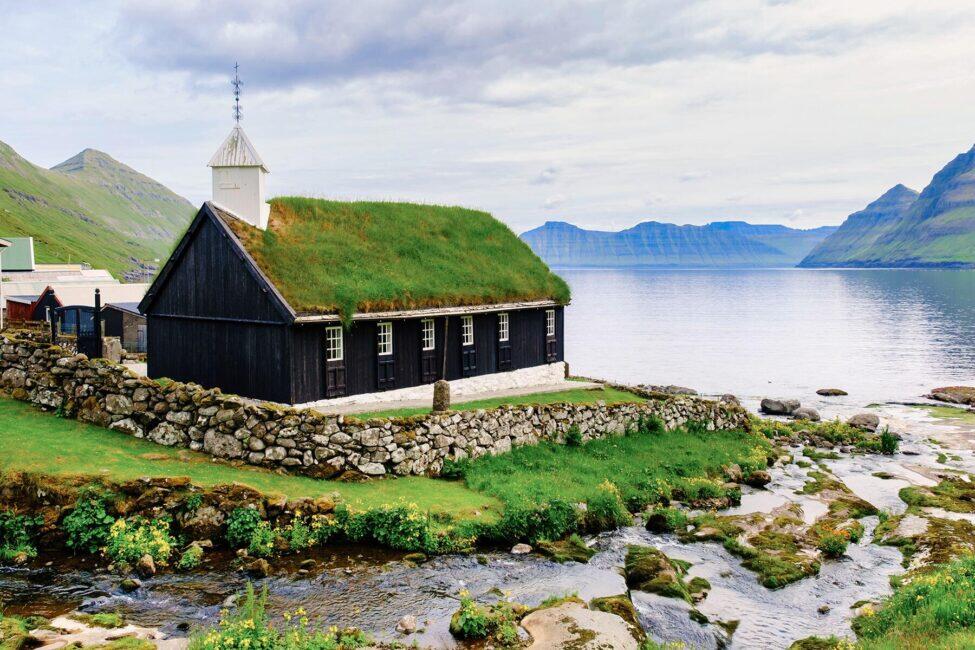
At each stop, the website updates when it geolocates you, and tells you a bit about where you are. My next stop was the historic church of Funningur, dating back to 1847. It’s right on the seaside in the little village, tucked into a steep fjord next to a glacial brook. The church, built with the traditional Faroese turf roof, complete with a blanket of green grass growing out of the top, opens its interior to visitors in the summer, but in the winter is generally only open for services. The map usually directs you to public parking, so I parked up the hill and walked down through a small neighborhood to reach the church, with the sound of the pebble brook for company.
Speaking of parking, it was almost by accident that I discovered a local quirk. Street parking in Tórshavn is free, but each parking area has a sign (in Faroese only) posting the maximum time limit for parking. Each car on the island has a clock on the inside of the windshield and uses the honor system – you indicate on the clock what time you parked, and if you park too long or forget to set the clock, you get a ticket. I learned the hard way, and found a parking ticket entirely in Faroese, which I deciphered, then figured out how to pay (they only accept bank transfer, which is uncommon in the U.S.). A small price to pay, I thought, for uncovering some local color, and I was sure to set the clock each time I parked thereafter.
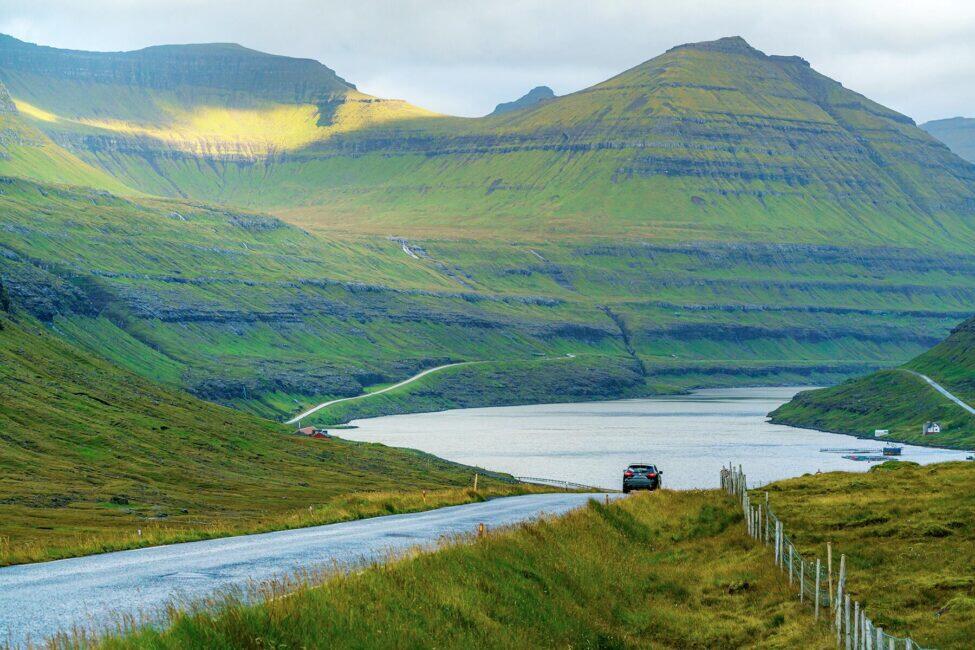
The tours over the next several days were a good mix of quaint villages, historic churches, and quiet hillsides with views of the water, but most of the fun was in the drive through dramatic, windy green hills capped with snow, dropping straight down to the rippling ocean.
Several of the islands are connected by undersea tunnels, some of which are several miles long. One of them even contains the world’s first and only undersea roundabout, where three tunnels converge. With the villages so far flung, car culture is pretty big in the Faroe Islands. Perhaps because of this, the gas station convenience stores are fantastic. If there’s one thing that’s consistently done well in the Nordics, it’s hot dogs, and each gas station I stopped into had a wide selection of them, which they serve in a roll that’s been hollowed out through the center instead of sliced.
On the last of four self-drive trips I took during my week, the program even suggested stopping at a gas station for a snack before directing me to take a winding road along a fjord to the tiny village of Skælingur, where I pulled into a parking lot to enjoy the snacks. Sensing I had reached the end of the trip, the description of the place pulled up on the itinerary, suggesting that I simply step outside and enjoy the quiet isolation, the wind, the sea spray, and the view of the ocean. Along the road, I couldn’t help but stop (there was virtually no traffic aside from some sheep), to photograph an old stone bridge signposted that it was built in 1912.
The self-drive trips can all be done in the space of a few hours—my longest one was perhaps four hours from start to finish, although if you’re traveling toward the end of autumn, as I was, it’s helpful to remember that the sun sets earlier at these latitudes, and it’s compounded by the surrounding mountains blocking out the sunlight by midafternoon.
When I wasn’t out communing with sheep, old churches, and misty sea breezes, I still had plenty of time to poke around Tórshavn, to see if there were any good books I had missed at the book shop the previous summer (there were), and wander around the surrounding shops to scope out their knitwear. I found myself sifting through some wooden boxes filled with knit caps placed out in front of a shop signposted Føroya Heimavirkis Felag, with a spinning wheel logo.
I already knew Føroya meant “Faroe Islands”, “Felag” meant “Company”, but heimavirkis? I’d read “Heim” meant “home”, and virkis—oh! Work! “Faroe Islands Home Work Company” or “Faroe Islands Crafts Company”. It was a knitting co-op! I found a cap I liked in a green and blue pattern that reminded me of the northern lights I saw the night before, and stepped inside to find two women sitting behind the counter—one older, and one perhaps early middle-aged. I found a pair of socks and stepped up to pay.
The older woman addressed me first in Faroese, which I found to be charming. I’d assumed in a country this small, everybody would immediately know I wasn’t from there—but virtually everybody used Faroese first. A small, but powerful assertion of their language and culture, I felt. We quickly switched to English, and I watched as she added up the totals on a handheld calculator, pulled tags off the items and stuck them into a book, which I knew from experience was how they tracked which producers needed to be paid. A win, I thought—supporting local knitters.
In a country where sheep easily outnumber people, it’s not surprising they’re known for the quality of their wool products, and local wool yarns seem to be just as readily available in local shops as knit goods themselves. The co-op I found myself in skewed traditional, but other boutiques in the immediate area had more contemporary designs—but I was happy to have happened upon the craft shop ladies and their book of stickers.
It wasn’t all gas station hot dogs and coffee-and-baked goods that week either. There are several good restaurants in Tórshavn. I had lovely tasting menus in a cozy little window table at Katrina Christiansen (before I knew it, I’d eaten the entire bread basket), and buttery snow crab at ROKS that I’m still dreaming of months later. For the more casually minded, or those who don’t want to sit through a tasting menu after a day of sightseeing, I had a pretty faithfully represented tray of barbecue brisket, fried chicken, pulled pork, and battered fries at OY Brewing.
To be sure, days spent exploring by the what-surprise-awaits-next internet app proved to be tiring, even with the massive breakfast spread at Hotel Føroyar to fuel it. The hotel is something of a landmark in Tórshavn, set on a hillside with views of the town and harbor. This is where post-Presidency Bill Clinton stayed during a 2007 speaking engagement, and the suite where he stayed is still named for him. He visited my favorite book shop too—they still have a photo from the visit tacked up on their wall.
On my last day in town—yet another sunny one—I took a break from the road and went instead to Ress Spa at the hotel. One of the ways the Faroe Islands differ from the rest of the Nordics is that they’ve never really had the formalized spa culture—the hot springs bathing of Iceland and the sauna-to-cold traditions of Norway, Sweden, and Finland never made it to these islands.
So, they were free to do it their own way, and the philosophy at Ress Spa is to immerse spa-goers in the Faroese elements—whatever they may be that day. I changed into the issued bathing suit (I had my own but they like you to wear theirs so they know it’s clean) and showered thoroughly, amused by the signage in the locker room that showed a diagram of a man with big red circles around his pits, head, and crotch—just in case there was any question about what body parts needed the most careful attention with the soap.
Then, it’s outside in the elements to the spa house, walking through a rock-lined trench in the green landscape, exposed to the wind (and sometimes rain and snow) before stepping inside. There are infinity pools that start indoors and go outdoors with views over a copse of pine trees, that I later learned were planted as a reserve (the islands are otherwise treeless – anything they try to grow gets blown over by the wind or eaten by the sheep).
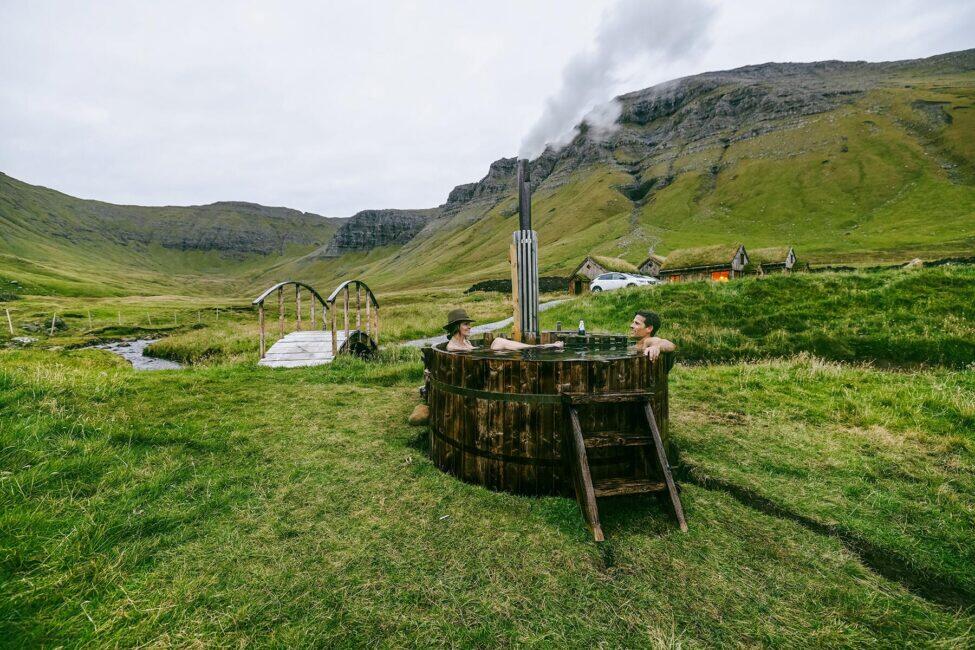
There are several saunas, a steam room with a steampunk-looking iron device that dips superheated volcanic rocks into a basin of water, creating mineral-infused steam, and a heated rooftop infinity pool where I sat, arms dangling over the side, pondering these delightful little islands where I’d spent a memorable, reflective week.
And just like the first time I visited ever-so-briefly on that cruise, I vowed once again to return.