
The late-afternoon light in Denver has that thin, high-altitude clarity that makes every surface look sharper than it should. I was rolling west on I-70 in the project car—old BMW wagon, suspension sorted, engine still a little too loud for polite company—when the news alerts stacked up. One about the Alliance for Automotive Innovation leaning hard on Congress. Another about an Audi CEO standing on a stage in Georgia next to the President of the United States. Same week, same industry, two very different kinds of theater.
Both stories are about the same underlying tension: who gets to sell cars in America, who builds them here, and what invisible systems ride along inside those cars once they leave the dealership.
The Permanent Ban Push
In early September 2026 the Alliance for Automotive Innovation—representing the companies that still account for the overwhelming majority of vehicles sold in the United States, including General Motors, Ford, Toyota, Volkswagen, Honda, Hyundai and others—sent a letter to congressional leadership. The ask was clear and urgent: enact a permanent ban on the sale, import, and manufacture of Chinese connected vehicles, related hardware, and software before the 119th Congress adjourns.
John Bozzella, the Alliance’s president and CEO, did not mince words. Chinese automakers, he argued, are dumping heavily subsidized vehicles around the world. Those vehicles carry connected systems capable of collecting, processing, and transmitting sensitive vehicle and consumer data. In Europe, Australia, Southeast Asia, Mexico, and South America the market share gains are already visible. The United States has so far been largely spared, but the Alliance wants that protection locked into statute rather than left to administrative rules that a future administration could reverse.

By early November, after the midterms, the group renewed the call. Lawmakers were returning for a short session. The window was closing. Bozzella pointed to the European numbers: more than 1.1 million Chinese vehicles imported in the first eight months of 2026 alone—more than the entire previous year. The argument mixed economic self-interest with national-security language. Generational investments in American plants and communities should not be undercut by state-backed competition that also raises surveillance concerns.
Existing barriers already do a lot of the work. Section 301 tariffs hit Chinese electric vehicles at 100 percent. Commerce Department rules phase in restrictions on Chinese-origin software for connected and automated driving systems starting with model year 2027 and hardware by 2030. In practice the U.S. passenger-vehicle market is already closed to Chinese brands. What the Alliance wants is permanence—legislation that cannot be undone by a simple regulatory rewrite.
Several bipartisan bills have been circulating. The Connected Vehicle Security Act advanced through Senate Commerce in July. House versions have gathered significant co-sponsorship. The core idea is consistent: treat Chinese connected vehicles and the critical software and hardware that enable them as a national-security matter, not merely a trade dispute. Some versions include ownership thresholds that have raised complications for companies with meaningful Chinese passive investment, most notably Mercedes-Benz. The Alliance has signaled it wants a balanced approach that does not inadvertently penalize its own members.
From the driver’s seat the abstract language becomes concrete. Modern cars are rolling sensor platforms. Cameras, microphones, location data, driver-behavior profiles, over-the-air update pathways—all of it creates a data surface. When that surface is controlled by entities subject to the laws and priorities of the Chinese government, the risk calculation changes. Whether every Chinese connected vehicle would actually exfiltrate sensitive information is almost beside the point for policymakers. The theoretical capability, combined with the scale of Chinese industrial policy, is enough to trigger defensive legislation.
Why the Timing Matters
Midterms always scramble legislative calendars. The Alliance’s September letter already flagged the risk that post-election dynamics could shrink the window for action. By early November the urgency had only increased. Some aides and lobbyists worried that a change in congressional control could make passage harder before the end of the year. The industry’s preference is clear: lock the policy in while bipartisan momentum still exists.
There is also a quieter strategic calculation. Chinese brands have proven extraordinarily effective at competing on price and feature density in markets that remain open. Battery costs, vertical integration, and state support have allowed rapid iteration. In Europe the volume has become impossible to ignore. Once a manufacturer builds scale and brand recognition outside China, the pressure to enter the U.S. market—through imports, third-country assembly, or eventual local production—only grows. Preemptive legislation is designed to close those pathways before they become politically harder to shut.
The data-risk argument sits alongside the industrial one. Protecting existing investment is not purely protectionist rhetoric. American and transplant manufacturers have spent decades and tens of billions building capacity, supplier networks, and skilled workforces. A sudden influx of lower-priced, highly featured vehicles could strand that capital. At the same time, the national-security framing elevates the discussion beyond ordinary trade policy. Once a bill is framed as defending critical infrastructure and citizen data, it becomes harder for opponents to dismiss as simple favoritism toward Detroit and its allies.
Audi’s Georgia Moment
While the Alliance was pressing Congress, another storyline was unfolding in central Georgia. In late October, President Trump announced at a campaign rally that Audi would build a $4 billion assembly plant near Macon, capable of producing up to 200,000 vehicles a year and creating roughly 4,500 jobs. Audi CEO Gernot Döllner stood on stage with him. The plant is expected to assemble large SUVs—Q7, Q8, and the forthcoming Q9—with production targeted for the early 2030s. Construction is slated to begin in 2027.
The optics were unavoidable. A German luxury brand’s chief executive appearing at a partisan political event weeks before midterms generated headlines in both the United States and Europe. Audi and its parent Volkswagen Group have faced significant tariff costs on vehicles imported into the U.S. Local production is one logical response. Döllner framed the decision as a long-term bet on the American market and a way to reduce exposure to trade volatility. The company has been careful to note that final investment decisions still require internal approvals, including those involving labor representatives on the supervisory board.
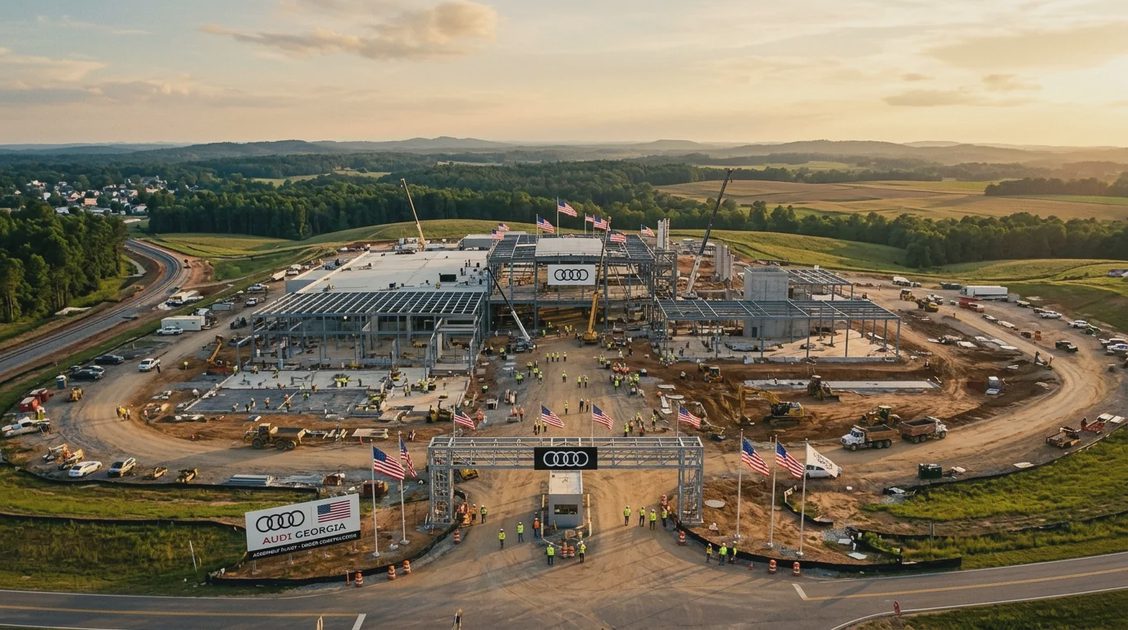
From a pure industrial perspective the move makes sense. Large SUVs remain a profitable segment in North America. Building them closer to customers avoids tariffs, shortens logistics chains, and signals commitment. Georgia has spent years cultivating automotive investment; the site selection followed sustained outreach. Yet the political staging changes the emotional temperature. In Germany the announcement landed against a backdrop of job cuts and plant rationalization discussions at Volkswagen. Union voices immediately asked for assurances that American expansion would not come at the expense of German employment.
The episode illustrates how intertwined trade policy, industrial strategy, and electoral politics have become. Tariffs are no longer abstract numbers on a spreadsheet. They reshape capital allocation decisions in real time. A company that once exported finished vehicles from Europe now calculates that a multi-billion-dollar U.S. plant is the rational path. Whether that calculation would have been identical without the current tariff environment is a fair question; the public narrative, at least from the administration’s side, credits the pressure.
What It Feels Like on the Road
I keep coming back to the sensory difference. Drive a modern connected vehicle and the cabin is quiet in a way older cars never managed. Screens bloom with information. The car knows where it is, what the traffic looks like ahead, sometimes even how tired the driver seems. That convenience is real. So is the data exhaust. Every connected feature is also a potential vector. When the manufacturer sits under a legal and political system that prioritizes state access to data, the risk profile is different from a company headquartered in Detroit, Wolfsburg, or Toyota City.
The Alliance’s letter is, in one sense, an admission of competitive pressure. Chinese manufacturers have closed quality and technology gaps faster than many expected. Price is still a weapon. If the U.S. market remains open in any meaningful way, the volume impact could be significant. At the same time, the security argument is not manufactured out of thin air. Democracies have spent the last decade wrestling with Chinese technology in telecom, drones, and social platforms. Vehicles that spend years on public roads and private driveways, packed with sensors and always-on connectivity, sit in a similar category.
There is a risk of overreach. Permanent statutory bans can become blunt instruments. Ownership thresholds that sweep in companies with passive Chinese investment create collateral damage. Overly broad definitions of “connected vehicle” or “related hardware” could complicate legitimate global supply chains. Good legislation will need careful drafting. The Alliance itself has acknowledged the need for balance so that its own members are not inadvertently harmed.
Still, the direction of travel is clear. The United States is choosing to treat the Chinese automotive industry’s global expansion as a strategic challenge rather than ordinary commercial competition. Europe’s experience with rapid Chinese import growth has become a cautionary data point. Canada and Mexico sit next door with different policy postures, creating potential leakage risks that U.S. policymakers will watch closely.
Looking Down the Road
Sitting in the wagon as the Front Range darkens, the political noise feels both distant and immediate. Cars are still machines that move people and cargo. They are also increasingly software platforms, data collectors, and symbols of industrial power. The Alliance’s push for a permanent ban and Audi’s decision to put steel in Georgia are two expressions of the same underlying shift: the rules of the global auto industry are being rewritten in real time, and national borders matter more than they did a decade ago.
Whether the legislation clears this Congress remains an open question as of early November. Momentum exists. So does the usual procedural friction of a lame-duck session. What is less uncertain is the broader trajectory. Chinese brands will continue to press outward. American and European manufacturers will continue to seek protected scale in their home and key export markets. Consumers will keep buying the vehicles that best balance price, features, and brand trust.
The road ahead will be interesting. Some of it will be paved with new plants and new jobs. Some of it will be restricted by statute. And all of it will be watched—by governments, by competitors, and by the quiet systems inside the cars themselves.