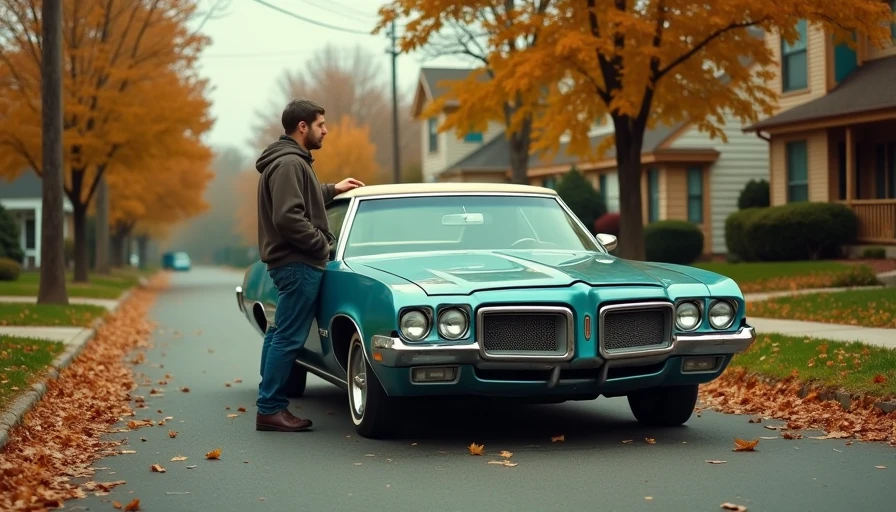
Roll down the window on a warm California afternoon and you hear it first—a low, throaty V8 rumble that sounds like it belongs to a muscle car from a different era. Then you see the long hood, the wide chrome grille, and the distinctive split tail. The 1972 Pontiac Grand Prix is one of those cars that arrives with a story already written. It doesn't just move through traffic—it parts it.
For anyone who grew up watching American cars of the early 1970s, the Grand Prix was the sweet spot between luxury and performance. Pontiac had been refining this personal luxury coupe since 1962, and by 1972 the formula was nearly perfect. The styling was aggressive but elegant, with a boat-like length that somehow still managed to feel nimble. Under the hood, a standard 400 cubic inch V8 delivered plenty of grunt, and the optional 455 made it a legitimate highway cruiser.
What Makes the 1972 Pontiac Grand Prix Special?
The 1972 model year was a transition point for American cars. Emissions regulations were tightening, insurance rates were climbing, and the muscle car era was winding down. But the Grand Prix managed to hold onto its character. The design was updated for 1971 with a new body and a more pronounced beak-like front end, and by 1972 Pontiac had dialed in the details. The Grand Prix SJ, for example, came standard with the 455 V8, a handling package, and special badging. Car and Driver called it "a driver's car that doesn't forget the passengers."
Inside, you got a cockpit-style interior with deep bucket seats and a full-length console. The dashboard curved around the driver, putting all controls within easy reach. The optional Rally Gauge Cluster included a tachometer and oil pressure gauge—signs that Pontiac expected you to enjoy the drive. The hidden headlamps and vacuum-operated hood scoop were theatrical touches that made every trip to the grocery store feel like a rally stage.
Behind the Wheel: Driving the 1972 Grand Prix Today
Sliding into the driver's seat of a 1972 Pontiac Grand Prix today is a sensory experience. The seat fabric is soft but firm, and the steering wheel is huge—a thin-rimmed piece of plastic that gives you a direct, unfiltered connection to the front wheels. The suspension is softer than modern cars, so you float over imperfections rather than pound through them. But that's part of the charm.
I spent a morning driving a copper-colored '72 Grand Prix SJ through the hills east of San Francisco. The engine idled with a steady lope, and every stoplight became a negotiation with my right foot. When the light turned green, I fed in the throttle gently: too much and the rear tires would break loose, too little and you'd miss the theater of it. The Grand Prix isn't a scalpel—it's a sledgehammer that can also dance. The optional disc brakes up front help bring things to a stop, and the power steering is light but not vague.
On the highway, the Grand Prix comes into its element. The long wheelbase smooths out the miles, and the engine lugs along at 2,500 rpm in top gear. The exhaust note is a constant, reassuring companion. You don't drive a Grand Prix to carve canyons—you drive it to arrive somewhere feeling like you just finished a well-earned meal.
Owning a 1972 Pontiac Grand Prix: What to Know
Finding a clean 1972 Pontiac Grand Prix today takes some hunting. Prices range from $15,000 for a driver-quality car to over $40,000 for a fully restored SJ with the 455. The most desirable colors include Sundance Orange, Adriatic Blue, and Lucerne Blue. Rust is the enemy—check the rear quarter panels, trunk floor, and the lower doors. Mechanical parts are widely available through specialty suppliers like Original Parts Group, so restoring one is doable for a motivated hobbyist.
The Grand Prix shares its platform with the Chevelle, so many drivetrain parts are interchangeable. That makes it easier to keep on the road than some orphaned classics. But don't expect modern reliability; you'll want a good mechanic who understands points ignitions and carburetors. The good news: when something breaks, it's usually simple and cheap to fix.
The 1972 Grand Prix on a Road Trip
This is the kind of car that makes you want to pick a distant destination and go. I plotted a route from San Francisco to Yosemite—about four hours each way—and the Grand Prix handled it effortlessly. The trunk swallowed two duffel bags and a cooler, and the bench seat up front meant my passenger and I could trade driving without any awkwardness. At the end of the day, sitting in the parking lot of the Ahwahnee Hotel with the Grand Prix's chrome glinting in the sunset felt like being in a movie.
If you're considering buying a 1972 Pontiac Grand Prix, think about how you'll use it. As a weekend cruiser, it's hard to beat. As a daily driver, prepare for single-digit fuel economy and parking lot anxiety. But as a statement of intent—a sign that you value style and substance over convenience—the Grand Prix delivers something modern cars simply cannot.
A year later, what I still think about is the way the car settled into a cruise at 75 mph, the engine just humming along, the wind noise kept at bay by thick glass and generous sound deadening. The 1972 Pontiac Grand Prix is a car that rewards patience and attention. It asks you to plan your moves and enjoy the process. And in a world of seamless automated everything, that feels more valuable than ever.